Thursday, March 26, 2009

Exchanging Bow for Baton

On March 17, famed violinist Maxim Vengerov will assume the conductor's spot on the podium of the Jerusalem Symphony Orchestra to lead his musical forces through a challenging program, which features Beethoven's Leonore overture No.3, the Triple Concerto by the same composer and Symphony No. 3 by Brahms.


"The rumors claiming that I have completely abandoned violin are premature," says Vengerov as he speaks over the phone from his Tiberias home. "How can I abandon the language I've been speaking from the age of four and a half? It is like saying, 'I am don't speak Russian anymore.' I have just put my soloist career on hold.
"But conducting demands a total immersion in the subject, while violin is also a jealous instrument - it calls for your utmost attention - so I decided not to flounce between the two, but to approach the conducting professionally. Maybe after conducting 20-30 symphonies and a few operas, I will be able to call myself a fully formed conductor. Then I will probably be able to combine my two careers."
But what caused the 34-year-old Vengerov - once a child prodigy and later an internationally acclaimed violinist, one of the major instrumentalists of his generation, to make this drastic switch?
Back in 2007, Vengerov suffered an elbow trauma.
"I could hardly move my right hand," he recollects.
During the year of this idleness of necessity, Vengerov discovered the entire world around him. In Russia, music studies are taken seriously, and particularly when a child is promising, he or she simply has no other life outside of training and playing music.
"Of course, I cannot say I was sick and tired of playing violin," says Vengerov, "but the violin repertoire is sort of limited and I felt that it was about time to look for new horizons. So at the beginning of 2008, when my elbow came back to normalcy, I exchanged the bow for the baton. I felt that at the age of 33, I was still able to learn new things. I doubt I would have done it at 50."
Vengerov explains that he hasn't forgotten his musical experience. "People often ask what my secret is as a violinist. I think it has nothing to do with interpretation or with my technique - it was already the same at the age of six - but it is about the sound. Because the information comes through the sound - at least this is what I think. My experience with the classical and baroque violin and with viola, as well as my personal experience as a human being - they are still with me. I believe that sometimes a conductor is able to breathe a new sound even into an established orchestra."
He accentuates: "The baton is a musical instrument, just like a violin or piano, but far more complicated. Here, I need to know not only my part, but the entire score; I have to immediately evaluate the orchestra's musical abilities and to create contact with each and every musician, in order to bring the composer's ideas to the audience. There is a lot to be learned."
VENGEROV FIRST started studying conducting 10 years ago with pianist and conductor Vaag Papian, who also used to be his accompanist. Papian, in his turn, was a student of the late Ilya Musin, the legendary Russian conductor, who, being denied a considerable career under the Soviet regime, taught generations of maestros - Valery Gergiev, Yuri Temirkanov and Rudolf Barshai among them - while remaining relatively unknown outside his own country.
"According to Ilya Musin, whom I regard my 'grand teacher,' similar to a grandfather," smiles Vengerov again, "the art of conducting lies in making music visible with your hands. A conductor must have expressiveness and exactness - these are incompatible. The conductor's challenge, therefore, is to find a way of combining them."
Nowadays, as a part of his conducting studies, Vengerov travels around the world to meet conductors, including Gergiev, to consult with them and to learn from them. He also conducts various orchestras and considers various position offers he has already received.
In addition to performing, Vengerov patronizes The Musicians of Tomorrow - a music school that he inaugurated shortly after the Second Lebanon War in the village of Migdal, overlooking the Kinneret.
"This subsidized project is aimed at all gifted kids of the North, and especially those whose parents are unable to afford music lessons. With Hizbullah rockets falling on the Galilee, I wanted to offer the kids an alternative, and nothing is as good and as supportive as music."
Maxim Vengerov conducts the Jerusalem Symphony on March 17 at the Jerusalem Theater's Henry Crown Hall. Eden Trio members Hed Yaron Meirson (violin), Bernice Keshet (cello) and Michal Teitler (piano) will appear as the soloists in Beethoven's Triple Concerto.
This article can also be read at http://www.jpost.com /servlet/Satellite?cid=1236764162572&pagename=JPArticle%2FShowFull
Mar. 12, 2009
MAXIM REIDER , THE JERUSALEM POST

Like Homecoming

Each time I head to Israel I experience a very special, homey feeling, which is similar to that of visiting my native Tbilisi, where my parents live," says US-based Georgian pianist Alexander Korsantia in a phone interview from Boston. "This is not because I've been to Israel on numerous occasions and the place is simply familiar to me. Rather, I have very close relationship with so many people there that a sensation of a long trip turns into an anticipation of a reunion with dear friends."


On February 27, Korsantia will play Rachmaninoff's Piano Concerto No. 3 at the Classics at the Red Sea Festival with the Mariinsky Orchestra under maestro Valery Gergiev, and later he will tour the country with the Israeli Camerata.
Yet even before that, he will stop in Warsaw, Poland, for a special recital, in which he appears with "wonderful young Georgian pianist Ketevan Badridze" to play Mozart, Ravel and Mussorgsky.
"A lot is to be done nowadays, especially by us Georgians, to show to the world the peaceful face of Georgia, to present its rich culture, to demonstrate its warm and humane facet, and as such to be more accepted by the rest of the nations," accentuates Korsantia.
Viewing himself as an ambassador for his country, Korsantia already in October 2006 made it a point to perform in Moscow, when the relationship between Russia and Georgia had deteriorated. "Our land is situated on the crossroads of civilizations and its culture has absorbed various influences from Asia, Russia, Eastern Europe and also the Mediterranean; this is what makes it special," explains the musician.
Today, it is most important for Korsantia to appear once again on one stage with "an outstanding conductor, Valery Gergiev - and not only musically, but also politically. We all remember the dramatic performance of his Mariinsky Orchestra on the ruins of Tskhinvali in August 2008, at the peak of the war between Russia and Georgia. It was dedicated to the memory of the Ossetians, who died in the city.
"For me, what was lacking was the notice of the Georgian victims - a war is always a tragedy for one and all, and I believe art and artists are able to transcend the borders dividing people."
Korsantia will dedicate the proceedings from the both concerts, in Warsaw and Eilat, to Yavnana, an international charity organization that supports the needy and the orphans - the victims of hostilities - in Georgia. The foundation was inaugurated some four or five years ago by a prominent Georgian singer, Paata Burchuladze.
FROM EILAT, the pianist will continue to Jerusalem, where he will participate in a series of concerts with the Israeli Camerata under its artistic director, Avner Biron, starting March 2. The program features two scherzi for solo piano by Chopin, Concerto No. 1 by Shostakovich, Metamorphosen by R.Strauss, as well as the world premiere of a piece by "a wonderful Israeli-Georgian composer and my dearest friend, Joseph Bardanashvili - I am proud and happy to find myself in this gorgeous musical company!"
Korsantia, who moved to the US in 1992, has finally landed in Boston, where he serves as a Professor of Piano on the faculty of the New England Conservatory. His pianist wife, a stunningly beautiful Neya, is a piano teacher, while their 21-year-old son Nicky is a science student - "and we both listen to what he tells us with our mouths wide open," says the warm family man.
Korsantia has nothing but praise for both the city, with what is "probably the country's richest cultural life," and the Conservatory and its traditions. "I have a large class of extremely talented students; regretfully, my studio is unable to accept everyone who wants to study with me, but when one student graduates, a new one enters. Some of my graduates are international contests winners. Time consuming as it is, I enjoy teaching and I try to combine it with my performing career," which spans both Americas, Europe and of course his city of birth, Tbilisi.
Alexander Korsantia plays with the Mariinsky Orchestra under Valery Gergiev on February 27 in Eilat; the Israeli Camerata March 2 at the Performing Arts Center in Kfar Shmaryahu; at the YMCA in Jerusalem on March 3; at the Wix Auditorium at the Weizmann Institute in Rehovot on March 4; at the Tel Aviv Museum of Art on March 5; and at the Performing Arts Centers of Herzliya, Ganei Tikva and Ashkelon on March 8, 9 and 10, respectively.
This article can also be read at http://www.jpost.com /servlet/Satellite?cid=1233304845054&pagename=JPArticle%2FShowFull

Feb. 22, 2009
Maxim Reider , THE JERUSALEM POST

Keeping haredim in the picture


'Religious Jews are often photographed, which is easy to understand," says tall and friendly photographer Menahem Kahana as he sits in a Tel Aviv beachfront cafe. "They are exotic and emotional. So when a photographer manages to capture a weird man in strange black garments, he more often than not believes that the job is done. But for me, this wasn't enough."

Kahana, who is presenting his exhibition of photos of the haredi community at the Eretz Israel Museum starting Sunday, would not approach the theme before he felt that he could say something new about it.

Not that Judaism was strange to Kahana. Born 50 years ago in Ashkelon to a family of observant Romanian Jews, he attended a religious school and later a yeshiva. After serving in the Golani Brigade, he was discharged from the IDF and settled in Jerusalem. At that time, he abandoned religion and became a secular man.

"I just did not feel much connection to religion," he admits simply.

Kahana was about 13 when his uncle gave him his first camera, and he was "immediately captivated by the magic of an image emerging in the darkroom from a sheet of paper, so the choice of future profession was obvious."

In Jerusalem, he entered Hadassah College, where he studied for only a year and without finishing the course. He then started working as a reporter for the daily Hadashot and local periodicals. Two years later, he became a staff photographer for one of the world's largest news agencies, Agence France Press.

"I shoot everything that AFP commissions from me," he says, "not only news, but also features: politics, rallies, sports, terror attacks, natural disasters - including that in New Orleans [Hurricane Katrina]. I shoot a lot in the territories and I spent half a year covering the disengagement from Gaza more than three years ago."

Kahana recollected that in Kfar Darom, young supporters from other settlements barricaded themselves on the synagogue rooftop. "I had to make my choice: to climb on the roof, where the real action would obviously transpire, or to stay on the ground. As expected, most of the awards went to those who covered the storm of the roof, but I do not care for prizes, they mean nothing for me. I decided to photograph the families being taken from their houses, because the real drama was there; unlike the youth on the roof, these people belonged to the settlement."

He described the feelings involved in such an assignment. "It was hard; sometimes I stepped aside to hide my tears. Maybe the entire decision to evacuate the settlements was right, but for those who lived there it was difficult to accept. They hoped that something would happen and they would stay. But again, photography is that kind of thing - it takes you out of any situation. Also, a photographer is always outside, not inside."

IT IS clear that Kahana's approach to photographing the Orthodox community was not merely ethnographic, either.

"I was just shooting their lives - their everyday life and feasts," says Kahana plainly.

His first photos of haredim were taken in 1995. At the beginning, he just took photos of the ultra-Orthodox in an unusual milieu. "There was a new movement in those days, a sort of return to nature. Some of the Bratslav Hassidim performed a ritual immersion not in a special bath, or mikve, but in springs."

Traveling with hassidic pilgrims as far as Uman in Ukraine, he photographed them immersing in the ice cold water on the eve of Rosh Hashana as well as visiting burial sites of the righteous people - tzadikim.

A busy press photographer, Kahana slated a day in every week dedicated to the theme, which he "chose for the soul."

But he says his former religiosity did not help him find his way into the ultra-Orthodox community. "I used to come as a secular person, without pretending to be what I am not. Also, the gap between the religious Zionists and the ultra-Orthodox is as wide as that between the secular and the religious. Every movement there has traditions and ceremonies of its own, and not many have ever heard of them."

Producing an average of 10 photos a year, Kahana shot the haredim only on film - and not digitally - until 2008.

"First, until recently, the quality of digital images was relatively low. Secondly, I wanted to draw a clear line between shooting for press and shooting for myself. In a way, shooting for newspapers is kind of technical photography, but here my visual language is far more sophisticated, compositions are complicated, with many inner connections and with rich light and color, which are extremely important for me. I also used different equipment: For newspapers, I shoot with industrial cameras, heavy and very expensive; here, I used smaller and lighter cameras with wide-angle lenses."

Aside from the eventual switch in camera types, Kahana says his project cannot really be described as a developmental process. "I do not think we can speak about development in photography. One of the series' best photos I took back in 1998. It has been widely published and depicts a demonstration of the ultra-Orthodox on an archeological site where human bones were found. They protested the excavations, seeing it as a desecration of remnants of the Jews. A mounted policeman is flying at us, one haredi has just fallen on the dirt road, his hat is rolling in the sand, the others are shouting. The renowned photographer Helmut Newton chose it as a Photo of the Century for the special Millennium issue of Time magazine. What could be better than that?

"Still, there was a development in quantity of the photos and of the themes."

Kahana explains that while working on his series, he had to make quite a few decisions, such as choosing themes and figuring out when to stop shooting a certain theme, which photos to include in the exhibition, etc.

"For example, I decided not to include photos of the kaparot ceremony [an atonement ritual that often involves a chicken and takes place on the eve of Yom Kippur]. Granted, as a press photographer, I have a lot of them, but this is not what I was after. Yet I included a photo of a huge religious man chasing a tiny chicken, which has obviously escaped from him, because there is a touch of humor, which gives it a different aspect."

REWARDING AS it is, photographing the life of the haredi community can get most tiresome, to put it mildly.

"Sometimes, you have to ride for several hours at night in a crowded protected bus, full of screaming teenagers, just to reach an Arab village over the Green Line where a grave of a tzadik is, and you do it over and over again. I traveled to the tomb of Patriarch Joseph in Nablus seven or even eight times until I was satisfied with the result of the shooting. It was a sheer nightmare. Other times you find yourself scolding a 13-year-old boy in order to get a place at the "tisch" [feast] at the admor's court.

And again, the photographer accentuates that his work is not an ethnographic one. "One can shoot an ethnographic series within a year - you just follow the calendar. I tried to dig deeper. Take the exhibition, and its catalogue, for that matter. For example, a photo of a bride who is about to meet her groom with her face covered, and a photo of a three-year-old boy, his face covered, too, because he is to meet the Hebrew alphabet for the first time. These two photos go together; and thus, by creating new connections, I am telling another story, a story of my own."

After a brief hesitation, Kahana sums up his work by saying "that we are all humans."

"It does not matter what we look like or what kind of clothes we wear. Inside, we are all the same, this is my message. I enjoy photographing the haredim just as I enjoy photographing Beduins or Palestinians.

"The visual richness is what makes it special."

Haredim - photos by Menahem Kahana runs at the Eretz Israel Museum in Tel Aviv from February 15 through June 30.

Curated by Alex Libak.
Feb. 15, 2009

MAXIM REIDER , THE JERUSALEM POST
http://www.jpost.com/servlet/Satellite?cid=1233304782063&pagename=JPost%2FJPArticle%2FShowFull

Sunday, June 8, 2008

New world citizen


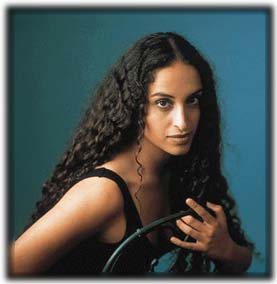
"For a creative artist at the beginning of the road, [it's natural] to reveal his or her own voice, but as maturity comes, you realize that you're just a link in a chain, in a dynasty, and you try and connect to your roots," says singer Ahinoam Nini.

And on this quest of discovery, Nini, who was born in Israel and grew up in New York, is promoting her new international album Genes and Jeans. On her current Israeli tour, the stunningly beautiful Yemenite artist is mixing Yemenite-flavored songs from the album with some of her older material.

Starting out with the idea of reviving Yemenite songs she had heard from her grandmother as a child, Nini "meditated on the old Hebrew/Yemenite lyrics, full of love and longing, of dreams unfulfilled, of pain, heat, dust and wind… and wrote new English lyrics and music, and wrapped them around the old songs like a long coat in winter," she writes in the album's liner notes.

Despite the specific cultural roots of Genes and Jeans, the album has been wildly successful internationally. Nini says: "I think that my songs find such a huge resonance because in the world of today, there are more and more people who are multicultural and who have roots in many places - I call them 'new world citizens,' which also connects to the virtual world... the need for self-identity has become even more crucial."

That said, she admits that she really does not know why people like her music. "Maybe because I have never done anything to be liked. Probably they feel that everything I do comes from a very deep place - as we say in Hebrew, 'I make my art for the name of Heaven.' This is my religion - and I am not a religious person. So this is a combination of artistic diversity, a lot of legwork - I have appeared in a lot of little places of which not many have ever heard - and yes, a bit of luck."

Nini has dedicated the album to her late grandfather, who, as she admits, has influenced her immensely. "He was a real dreamer, an adventurer, a self-made man. A diamond cutter, he established his family in Israel and embarked on a journey through the world. He did not have even a basic knowledge of English, but he had intuition, a huge smile, charisma, a great belief in people and the ability to communicate. And even if some of those things did not work and his trust in people has betrayed him, he was optimistic to his last day. I hope I have inherited something from him."

NINI BELIEVES that her peace activism, in which she has been involved for years, was also inherited from her grandfather. "The belief in peace, to believe that there are people on the other side - there's no reason for not stretching out a hand," says the artist, who has sung for the pope and has collaborated with many Palestinian colleagues. "This is all in [my grandfather's] spirit - putting your heart on a platter and believing that what comes back will be good."

Returning to the present tour, Nini can't say enough about her great fortune to work with a team of "talented and tasteful people, such as director Daniela Michaeli, lighting designer Bambi and stage designer Neta Hacker, among others. This is a beautiful show, with many things happening onstage."

And onstage, Nini projects her identity proudly. As an international artist, Nini has never tried to hide her Israeli roots. "For many people throughout the world, I am their only contact with Israel - except for CNN - and people receive a totally different image of Israel when they see me onstage. And also my peace message - I do it not because it is popular, but because I believe it is possible and I do what I can."


THE JERUSALEM POST Jun. 8, 2008

Saturday, August 11, 2007

Capturing my husband's roots

'I believe that Micha was with me in India, he looked through the lens of my camera together with me, and we took these photos together," says photographer Michal Yehezkel in a Tel Aviv café in front of the Cinematheque, where her exhibition "Spirits" is on display.

Micha is Yehezkel's late husband who died of cancer less than three years ago at the age of 47. A Jew of Indian heritage, he came to Israel at the age of 10 and always dreamed of visiting the land of his birth, but never realized his dream. Two years after her husband's death, Yehezkel went to India in lieu of her husband, in search of his roots.

"I've always taken photographs, but four years ago I decided to study photography properly." Yehezkel, who was born in Israel but spent her early years in New York, returned to Israel at the age of 18. "My appointment at the photography studio was scheduled for the day my husband was diagnosed with cancer - the day my world turned around."

Yet Yehezkel, who knew what awaited her in the coming months, decided not to cancel her studies, and photography turned out to be a large part of what helped her survive her ordeal with some sanity. She made portraits of her husband "on his heroic descent down a slope of no return. I am usually a very quiet person, and I spoke out through my photography."

"I've always been full of joie de vivre, we had a great life together - he was my soul mate, and we have wonderful kids."

Yehezkel, who has been active on photography Internet forums, says that when the news of her husband's death spread through the Web, "many people, strangers, came forward to comfort me - this is the [power of the] language of photography."

About a year ago, when Yehezkel was still deep in grief, her friends invited her to participate in a photographic journey to India.

"I agreed without hesitation, not even knowing if I would be able to photograph," recollects Yehezkel. "This was a very hard period. I was stuck, I was lost. I said to myself, 'Michal, stop crying, you have to get better, to do something drastic.'"

When she went to the Indian Embassy to acquire a tourist visa, Yehezkel was asked if she planned to travel for business or pleasure. "Neither," she responded, "I'm going to the land where my love was born, I am going there for healing. I hope next time it will be for pleasure."

Speaking about the journey, Yehezkel says that she "was drawn to certain images which only became clear to me once I returned home and observed them. Unconsciously, I was photographing themes of symbolic significance to me. Many of the photographs are characterized by powerful contrasts of light and darkness, happiness and sadness, past and future."

The results of her photographic journey are now exhibited at Tel Aviv Cinematheque. "I kept the title of the exhibition in English, since 'The Spirits' has a multifaceted definition; it is human spirit, soul, morale, and also alcohol.

"Micha, who was a very practical person and absolutely not superstitious, used to say: You should not be afraid of the spirits, they are here to protect us."

Preparing the exhibition turned out to be a healing and awakening process for Yehezkel. "It was like a rebirth. I was surrounded with death and grief and then I did something different. By sharing my internal pain with other people through my photos, I may be to help those who are in my same situation. For me, this exhibition is like closing a circle. First you feel anger and pain, then reconciliation comes.

"I consider myself an eternal optimist, always in search of the aura and flora in this world, despite the sadness, despite the darkness. With my photography, I search for the same things I search for in life - light and color. And now I am looking forward to my future."

'The Spirits' will be on display until August 22.


This article can also be read at http://www.jpost.com/servlet/Satellite?cid=1186557404631&pagename=JPost%2FJPArticle%2FShowFull

Tuesday, June 5, 2007

Just checking


Hi all!
I am just checking the new service. Later I will create kind of a reference page of mine, with photos and articles, just to keep for the posterirty my artistic output.